Tales of a Midwest Lutheran on the East Coast

Tuesday, January 31, 2017

12-4-16: Make Room for the Kingdom

My call sermon at Family of God Lutheran Church on December 4th: 

Grace to you and peace from God our father and from our Lord and Savior Jesus the Christ. Amen.

Imagine, if you will, what a “John the Baptist Christmas card” would look like.  We see pretty much every other thing every other thing associated with Christmas on cards… so why do we leave out John the Baptist? Perhaps such a card might look something like this – a big hairy man with crazy hair out in the desert, knee deep in the river he has been baptizing people in, with a Santa hat on, singing “I know if you’ve been bad or good, so repent for goodness sake!” Or maybe holding out a tray of honey covered bugs and saying “I made you Christmas cookies!”

But of course John the Baptist doesn’t bake cookies or stand still enough to get his likeness on a Christmas card. He is far too busy baptizing, of course, which is well, you know, part of his name, after all!

Often we associate baptisms with babies, because babies are cute, especially when they cry when the pastor pours the water over his or his head. Often too we think about Jesus coming to us as a cute baby as we head toward Christmas, like the chubby infant pictured perfectly clean and happy on Christmas cards.

But John the Baptist reminds us that the coming of Jesus is not about cute babies or Christmas cards. Christmas is actually an invasion. Not an alien invasion or a British invasion, but a divine invasion. This is an invasion, not of weapons and power, but of peace and love. Jesus is about to invade our own world, and enter fully into our realm that is ruled by sin, death, and the powers that defy God. And the sign of this invasion in your baptism.

Jesus enters our world so that he can snatch you out of Satan’s hand, right out from under his very nose. Dietrich Bonhoeffer, a Lutheran pastor in Germany during World War Two, who lived out his baptism in some very scary times, wrote that wrote that, “Christ invades the realm of Satan, [and] lays hands on his own…” (The Cost of Discipleship). 

That’s you. You are his own. When the water was being splashed on your head, Jesus was saying, “Excuse me, this one is MINE.”

We became God’s children and given the promise of being part of God’s kingdom forever.
But the world tries hard to convince us that we aren’t children of the promise – that instead, we are children of snakes. “Brood of vipers,” to quote John the Baptist. People like the Pharisees and the Sadducees. Pharisees who were the religious score keepers. And the Sadducees had cozied up to those political power – the Roman government, who had conquered their people and ruled with a heavy fist.

The Pharisees and Sadducees heard the snaky voices of the world calling to them, voices that said following “the rules” are the way to earn God’s love, and that seeking after power and influence are more important than seeking God’s justice. We hear the same voices calling to us every single day from every direction. These voices tell us that following certain rules or lifestyles will make us more deserving of God’s love and those who fall short are worth less than us. These voices tell us that seeking after more money, power, success, the newest gadgets, and the most popular friends is the right way to live our lives.
And right now, when we in the church are celebrating Advent but the rest of the world is in full-blown Christmas mode, the voices tell us that our Christmases are supposed to look and feel like the most perfect Hallmark card.

Those voices, for all their promises of happiness and fulfillment, do not deliver. Following these voices takes us down a road that ends in credit card debt, strained relationships, a planet in peril, conflicts and wars and poverty and national anxiety, leaving our lives as dead as a stump left behind after chopping down a Christmas tree.

Another voice, coming from John the Baptist, a voice from the wilderness cries out that the kingdom of heaven is coming near to us. We are Children of the Promise, and the promise is about to be fulfilled. It’s time to remember who we are. It’s time to remember what kingdom we belong to. We belong to a kingdom where new shoots grow out of dead stumps. We belong to a kingdom where the old, “snaky” person in us dies, so that a new person, a new creation in Christ, can be born. It’s time to get ready for this kingdom to arrive.

But there is certainly a lot of junk left over from the old life, the “brood of vipers” life that is cluttering up the way and making our paths of following Jesus pretty crooked. This extra stuff needs to be given up and left behind – like getting rid of extra files on your computer or apps you never use on your smartphone so it can run faster. Or like those boxes that you take with you on every single move, boxes you have not opened in five or ten years, boxes that are filled with things you can’t even remember. But every time you see them you think, “Gosh, I shouldn’t get rid of this, what if I need it later?” So you drag it to your next move so it will take up room in your closet for the next five years. 

Let me remind you what’s in those boxes we’re carrying around. Things like trying to keep up with the Joneses and having the picture perfect Christmas. Things like the fear of people who are a different gender, sexual orientation, were born in a different country, celebrate a different religion, and those who struggle with homelessness, addiction, or mental illness.
We are told to cling to all the things in these boxes, but none of these things belong in God’s kingdom. These things need to be left behind, in the kingdom of snakes. These things belong by the side of the road along the way of the lord.

In the baptismal liturgy, we are asked if we renounce the devil and all the forces that defy God, the powers of this world that rebel against God, the ways of sin that draw us from God. Our response is to renounce them, to abandon them, to turn our backs on them.

We renounce them when we use our income to give back to our communities to help those in need, or to patronize businesses that ethically treat their workers and the environment.

We renounce them when we do not give into the messages of hate and fear, or listen to the loud voices telling us that some of God’s children are worth less than others.

We renounce them we make way for the needs of someone else rather than looking out for ourselves first.

Renouncing these boxes is really hard, though. We will be called to live differently than many of the people around us, even our friends and family. We will be called to leave behind what feels comfortable or secure. Others may see us as weak, as easy marks, as losers, as not keeping up,” or being hopefully out of touch.

In our baptisms we were given everything, but we were also given a call to follow. We may not be imprisoned or beheaded as John the Baptist was, or to be sentenced to death in a Nazi prison camp like Dietrich Bonhoeffer. But we will be called to make tough choices in our daily living. As Bonhoeffer also wrote, “When Christ calls [a person], he bids [them] come and die.”(The Cost of Discipleship) 

In our baptisms, though we have died with Christ, we have also been raised with him in new life. It’s scary and wonderful newness.

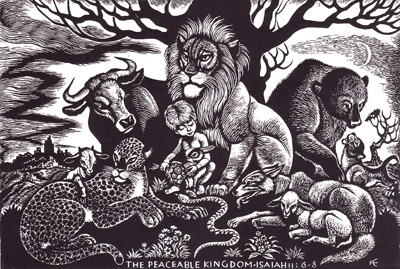
Isaiah reveals to us the vision of what we have to look forward too, as we make room for the coming of a new kind of kingdom in our lives. Isaiah describes a world where mighty predators coexist with the most helpless and vulnerable among us. A world where the powerful and the powerless live together in peace.

We may even recast Isaiah’s vision in different ways. What do you imagine the coming kingdom of God to look like? I think it might look something like this, from the reflections of a colleague: “The CEO will dream with the peace activist … the senators will dance with the undocumented farm workers … the American military leaders will dine with Pakistani mothers… children from all nations will play together and learn together and grow in to their full God given potential … animals and the earth will be treated with respect and care … war will cease and they will not harm anywhere in this holy creation “ Now THAT would be a pretty amazing thing to see on a Christmas card, wouldn’t it?

This is the vision of how life can be that we are making room for - the vision of a new kingdom getting ready to be born in the world, a kingdom you are a part of. This is the kingdom we are turning TOWARD, turning to face as it arrives, like the dawn that comes after a long dark night, like a shoot growing up from a stump long thought dead.

Leave those boxes behind. God is doing something new. Thanks be to God. Amen.


Monday, January 9, 2017

Final Sermon at St. Paul Lutheran

Epiphany Jan 8th 2017
Grace to you and peace from God our father and from our lord and Savior Jesus the Christ, amen.

One of my favorite Christmas movies is the Muppet Christmas Carol. It’s an adaptation of Charles Dickens original Christmas Carol, with Jim Henson’s famous Muppets. Kermit the Frog is Bob Cratchet, Gonzo is Charles Dickens telling the story, and Michael Kane is the “regular human” playing a wonderfully grumpy Ebenezer Scrooge.  Naturally, it IS a musical, and in one of the songs the Ghost of Christmas Present sings these words: “[Christmas] is the season of the spirit. The message, if we hear it, is make it last all year.” And at the end of the story, when Scrooge wakes up on Christmas morning and realizes he gest another chance to right a lifetime of grouchiness, he exclaims, “I WILL honor Christmas, and try to keep it all the year!”

And Scrooge is right, Christmas is not just one day on the calendar. Long after the 70% off sales are over and the rest of the world has moved on, we are still celebrating Christmas, all twelve days, to be exact. And, following the example of Ebenezer Scrooge, we too honor Christmas during the rest of the year, by living our lives as if every day were Christmas Day. And that means, though our trees may be put away and normal life may be in its full, hectic swing, it means the work of Christmas is never done. 

Canadian Catholic theologian Michael Dougherty writes, “When the carols have been stilled, when the star-topped tree is taken down, when family and friends are gone home, when we are back to our schedules – The work of Christmas begins: To welcome the refugee, to heal a broken planet, to feed the hungry, to build bridges of trust, not walls of fear, to share our gifts, to seek justice and peace for all people, to bring Christ’s light to the world.”

We, who are fellow bringers of this light of Christ, celebrate 12 days of the season of Christmas, ending on the day of Epiphany, Jan 6th, which was Friday this year. Epiphany celebrates the light of Christ coming INTO the world in order to be given TO the rest of the world. Epiphany reminds us that Jesus was born for US too. It is the day when our familiar manger scenes are finally complete, with the addition of our three “king” figurines joining Mary, Jesus, Joseph, shepherds, and various animals.

A favorite youtube channel of mine, “Adam Ruins Everything” is a short show that does exactly what it sounds like…. Ruins things that you thought you knew all about. I apologize in advance doing my own little segment called “Pastor Lydia Ruins Epiphany.”

 So, our familiar crowned figures didn’t actually show up one the night of Jesus’s birth… or even 12 days later. They didn’t arrive on the scene until … MONTHS or even YEARS later. And by the way, they even weren’t actually kings.  “We Three Kings of Orient Are,” while a great song, is not entirely true (though the choir sang it beautifully just a moment ago!). The men we think of as kings are actually astrologers from an unknown eastern country. There might have been three, two, six, twelve or fifty. We don’t know. But we DO know that there ARE three gifts, all fit for royalty - gold for obvious reasons, frankincense and myrrh, both those used for both anointing and embalming.

But there are KINGS here in today’s Epiphany story. However, there are not THREE, but TWO kings. One of them is a false ruler set up to be a puppet king of by the absentee power of Rome – and he is certainly NOT the fun kind of puppet like in A Muppet Christmas Carol. The other king is the true king of the universe, the Lord of Lords, with a star to herald his birth. And no two kings could be more different.

First, though, we have to go back into our time machine of choice – TARDIS, Scooby Doo Time Machine, DeLorean – to last week’s reading from the Gospel of Matthew, which actually happens AFTER today’s reading Did you catch that? It is a little confusing. 

Anyway, AFTER the wise men fade from sight, Herod finds out how wise they actually are by giving him the slip. This sets off Herod into a rage, and because he felt so threatened by this toddler king that he ordered the mass murder of all the children under two years old in and around Bethlehem. This is what the dream that Joseph had warned him about, and he took Jesus and Mary to safety to live as refugees in Egypt until Herod died.

Herod is a king that you want to avoid, rather than seek after. Herod is a childish king, a manipulative, power-hungry, insecure baby-murderer. Instead, the wise men were led to the child King, who was God in the flesh and the light to all the nations. This child king would later grow up to keep making powerful people – like Herod – tremble in their boots, by turning the “world order” on its head. This child king grew up to bless the poor, make the last first, and grant his people life by way of an instrument of death that we invented. In the Jesus regime, as described in Psalm 72, Mary’s song, and many other places - the needy are delivered, the poor are given justice, and their oppressors are crushed.  The light of this king shines forth in the darkness of the world, and we will be able to arise follow this light where it is leading us.    

The road that the wise men were led on took them far from home, through a strange country, and into the path of some scary people. But they were always guided by the constant light of the star. And, after finding Jesus, they were still guided out of harm’s way by taking a different road. They took a path that was unknown to them, but they knew the one who was leading them on their way.

A prayer I have prayed often, which is found in our hymnal, is known as “The Servant’s Prayer." It goes: “O God, you have called your servants to ventures of which we cannot see the ending, by paths as yet untrodden, through perils unknown. Give us faith to go out with good courage, not knowing where we go, but only that your hand is leading us and your love supporting us; through Jesus Christ our Lord.”

What roads led you here today? All of us in the middle of this venture we call life, where sometimes the path ahead of us is hard to see and full of unknown challenges. Sometimes this road feels long. Sometimes this road takes us past all kinds of people, some of whom may be “Herods” in disguise.

Sometimes the path takes us to new places, away from the familiar, in order to do a new things and start new adventures. Sometimes our path takes a new turn, and we go by a different road than we had imagined ourselves following.

None of us really have any idea where this road will take us, but we know to WHOM this road is talking us, and who is guiding us along the way. Along the way, we find Jesus. And we are always guided by his light and love.

When the wise men found Jesus, they did not END their journey there, just as Christmas does not end on December 25th. Finding Jesus only caused them to get back out on the road. Like many of the wise men and women who have gone before us, we too are called to keep putting one foot in front of the other, continuing to do the work of Christmas by living the Jesus regime –“welcoming the refugee, healing our planet, feeding the hungry, building bridges, not walls, sharing gifts, seeking justice and peace for all people, bringing Christ’s light to the world.”

By Chinese artist He Qi
Hopefully we do go out “with good courage, not knowing WHERE we go,” but knowing that the hand of God is leading the way, like a bright beacon of hope, and the love of God is keeping us going, like an ever present companion. The path twists and turns, it goes through scary and beautiful places. But no matter where it may take us, we are going to be ok.

I have been taking down the wall art I’d hung up to get ready for moving to the next venture that God has called me to. One is a picture that hung in my office, a gift from another goodbye, of baby Moses in his basket of reeds, rescued by the princess of Egypt, after having been sent forth by his sister Miriam in the hope that God would make his journey a safe one. 

Another is a cross made out of broken ceramics put together with wise women, as we embraced our brokenness together and made something new and beautiful out of the broken pieces.

Another is a quote from C. S. Lewis, painted on wood reclaimed from the scrap pile, which says, “Courage, dear heart.” It’s a quote from one of his Narnia books, The Voyage of the Dawn Treader. The crew of the ship The Dawn Treader are lost in a magical cloud of darkness, and all despair of ever getting out. Then a white albatross flies overhead, whispers something to them, and then leads the way out into the light. What did albatross whisper? “Courage, dear heart.”


Take courage, dear heart, on all the paths the God takes you. Courage, dear heart, when the Herods of the world seem to loom large. Courage, dear heart, when traveling out on a road different than the one you arrived. Courage, dear heart, and keep walking. Amen.

Tuesday, January 3, 2017

Christmas Selfies

Christmas Day 2016
Grace to you and peace from God our Father and from our Lord and savior born to us this day, Jesus the Christ, amen.

A light shines in the darkness
(of the mall...) 
At the beginning of December, five youth and three adults, including myself, descended on the unsuspecting Quaker bridge mall to hunt for signs of the season of Advent. We were successful, and had fun taking selfies of ourselves looking for Advent when the rest of the world was already in Full-On Christmas Mode.

These were some of the selfies we took together: following a star like the wise men. Finding things, like trees and shoes, that were the color of advent, which was …. (Blue). Wearing a fur coat and giving our best impressions of John the Baptist. And my personal favorite, riding the down escalator, pretending to be the heavenly host.

But now Advent is over, and Christmas has actually, for real, finally here. But with it comes all the accompanying trimmings, including food, presents, stress, lights, carols, travel, family, traffic, and Christmas cards with pictures of happy family members with smiling, well-groomed children.

We of course want to share ourselves with family and friends at the holiday season, especially ones we can’t be with or haven’t seen in a while. But we never send out the picture where little Bobby is pulling Susie’s hair, when the baby won’t stop crying, or where Uncle Tim is arguing with cousin Billy, or the dog is chewing Grandma’s shoes. Instead, we send that one perfectly prepared moment when everyone is sitting still and looking great in their Christmas best.  


And similarly, the rest of the year, for those of us who post pictures and selfies on social media, we try to find the best angle or the best light, and we use filters and Photoshop. We curate and control how the world sees us - enhance the good, minimize the bad – so that we show the world, not our actual faces,  but our best faces, prepared for your viewing pleasure.

And at Christmas time, we go into overdrive. Weeks ago I started seeing so many pictures of Christmas trees and advent wreaths and churches being decorated for Advent. And as the weeks progressed, I saw pictures of people decorating Christmas cookies, posts complaining about traffic or lamenting about finding the “it” gift of the year – and also many, many people sharing how they couldn’t believe Christmas was almost here, and how woefully unprepared they felt for it to arrive.

Every year we strive to make Real Life look like what we send out in our annual Christmas cards. We’ve been prepping for months now, but still there hasn’t been enough time. What if we couldn’t find the almond bark or find time to bake and decorate cookies this year? What if the tree never made it up or decorated, or if you didn’t get as many gifts for the family as you usually do?

What if we’re not ready for Christmas to arrive? Will it still feel like Christmas? Will Christmas still come?

A friend of mine shared with me that she was looking back on past photos she shared on Facebook around Christmas time in past years. She remembers feeling surprised to see that five years ago, she and her husband had put up almost no Christmas decorations. That happened to be the year that her daughter was born (on Christmas Eve, no less!). Five years ago, though they had prepped for their daughter and NOT for God’s Son, Christmas still arrived.

Poor Mary and Joseph were certainly NOT READY for Christmas to come. They weren’t even in the comfort of their own home when Jesus was ready to be born. Instead, they were far from home on a road trip not of their own choosing, in a strange town with no room for them. Can you imagine Mary’s dismay when she realized that her contractions has started and she was going to deliver the promised Son of God RIGHT THERE, among these animals? And can you image Joseph fighting his panic when he realized how unprepared he was to act the midwife at Mary’s delivery? As NOT ready as these two were, they did the best they could with what they had, bands of cloths and manger and all. And Jesus still arrived.

The shepherds were not ready at all to receive the news about Jesus’s arrival either, during that night as they watched over their flocks on the night shift. And nothing on earth could have prepared them for witnessing the heavenly host arrayed in the sky, singing and praising God for the birth of a savior who is the Messiah, the Lord. The only response they could think of to this amazing announcement was to go see him for themselves. So they high-tailed it out of there and descended on the poor, unsuspecting Mary and Joseph, who with these visitors, got their second surprise of the night.

Many of Jesus’ own people weren’t ready for him when Jesus arrived on the scene, especially when he began preaching about the kingdom of God and healing people and hanging out with the wrong crowd. John the Baptist did his best to try to get people ready for his coming, and we certainly had our fair share of hearing this from John the Baptist during this Advent. But many people didn’t recognize Jesus as who he was, as the reflection of the image of God, and others chose NOT to see. After all, Jesus disturbed their picture of God, one of a  God loves some more than others, a God who cares more about following rules than about justice and peace. And so, some rejected him, because Jesus was a threat to the image of God they preferred to see instead.  

But ready or not, Christmas still came. Ready or not, Jesus still arrived. Ready or not, the light still shines in the darkness.

Jesus came to us as the image of God, the picture of who God is and how God wants to be seen. This picture is not filtered or “cleaned up” to look nicer in with filters or Photo shop. Jesus came to be with us in the grittiness of life, born into existence with dirt and animals. Jesus pitched his tent and moved into the neighborhood, became flesh and blood and lived among us, so that he could be present with us in the NOT so “picture perfect” times.
Jesus came into this word to experience those not so “picture perfect” times too. He experienced loss and rejection, grief and pain, suffering and even death – all the things that we would rather edit out of lives. Jesus chooses to be with us in the unedited version of our stories, to reveal to us that our stories, as unfinished and rough as they are, are part of God’s story.

Jesus entered into that story on Christmas Day. And the good news today is that the light HAS dawned upon the world, that Christmas HAS come, because here we are. We made it – we “made it” to this day, but we did not “make it” happen. We don’t have to make, strive for, find, or “save” Christmas, contrary to all the popular Christmas movies on the hallmark channel and songs on the radio. Christmas arrives, whether we are ready or not. Christmas arrives and Jesus appears, and we get to witness it as it happens. Just as Mary, Joseph, and the shepherds all did.

We, though, are unable to jump in a time machine and go back to witness the actually birth of Jesus. But we are still able to witness the arrival of Christmas today. Like Charles Dickens’ “A Christmas Carol,” with its spirits of Christmas Past, Present, and Future, WE can say about Christmas that Christ came, Christ is coming to us now, and Christ will come again at the end of time. And in the present moment, Jesus is arriving all the time, all over the place. Think of these as the “Christmas Selfies” of Jesus, and our job is to find them, like a real life Christmas selfie scavenger hunt.

But what would these snapshots of Christmas arriving look like in our actual lives?

A Christmas selfie in real life might look like a friend of mine who, after witnessing a Kmart employee being chastised by a customer in the Layaway department, deciding to make an anonymous layaway payment for a stranger, and that made the Kmart employee’s day.

A Christmas selfie in real life might look like the time another friend had just started as the pastor of a church who agreed to make a meal and be a host overnight for a homelessness program, for the very first time, on the night of Christmas Day.

A Christmas selfie in real life might look like our Christmas pageant last Sunday, written by one of our own youth, when we witnessed a talking animal telling a scared and lonely foster child that “Christmas is the perfect time to welcome a stranger.”

These are just some of the selfies of Jesus shared with us in 2016. I’m sure that you all have witnessed others, and will be witnesses to many more in the years to come. You don’t need a smart phone or filters or fancy equipment to witness them. You don’t have to be completely ready or totally prepared in order for Christmas to arrive in our lives.

Christ was born for this. Christmas is HERE. Jesus happens. Every year. Every day. Right here and now. Amen.


Tuesday, December 13, 2016

Here is Our God.

12-11-16
Grace to you and peace from God our father and from our Lord and Savior Jesus the Christ, amen.

Every Advent I feel like I want to start strong, with the motivation to read daily devotions, taking time to really reflect on the specialness of the Advent season and the coming of Jesus into our lives. Most years though, like this one, I get to about this point and realize I have done exactly zero of the things that I had intended to do, whether because of busy-ness or the unexpected happening in my life.

Don't worry, I'll be back after
Christmas to clean up!
I think we’ve all had Advents and Christmases that go something like this. A few years ago, my extended family waited to celebrate together because Grandpa was in the hospital over Christmas. And more recently, for these last two years, I haven’t put up a Christmas tree – last year because I had just moved, and this year because I anticipate moving. But this year I was able to get my Christmas tree fix while I was in Wisconsin over Thanksgiving. As I took ornaments out of the boxes, my mom reminded me of a time a few years ago when I was home for Christmas break while in college. I don’t remember doing this, but apparently I had insisted on decorated the tree that year, but when I left to go back for the January term… guess who was left to take all the ornaments down again? Not me! Oops! Most years, my mom likes to remind me of this time where I didn’t finished what I had started.

How is your Advent going? Are you going to finish strong, or did everything go off the rails starting December 2nd? These texts for this 3rd week in Advent aren’t exactly helping, either. There is still no sign of Mary, Joseph, angels, shepherds, wise men, star, manger, no Christmas NOTHIN’. Instead, all we have is John the Baptist, for the second week in a row. And he is NOT one we usually associate with Christmas cheer.

This week he is no longer “the preacher on fire” in the desert, preparing the hearts and minds for the coming of the Lord. Instead, John has been thrown in prison for his bold words. A prison that was more like a dungeon, dark and damp and full of chains and despair. But how did he get from “Israel’s Most Famous” to “Israel’s Most Wanted”? Well, we’ve skipped over all the in-between chapters in Matthew where Jesus heals the blind, mute, lepers, and young girls, and Jesus gives the Sermon on the Mount about peace and the Kingdom of God, where Jesus hangs out with fisherman and tax collectors and Roman soldiers. And generally NOT acting like the expected Messiah.

The Lord’s anointed was SUPPOSED to come with power and might, with lots of righteous judging and fiery smiting, and be a savior that basically kicks butt and takes names, with the kingdom of peace to come LATER. That was the script that Jesus was supposed to follow. And so far, he doesn’t seem to be exactly living up to those expectations. He doesn’t seem to be finishing what John started.

It’s no wonder that John the Baptist sends people to ask Jesus, “are YOU the one who is to come? … or is it someone else?”  And we might very well wonder right there with John, as he watches Jesus’ ministry unfold, and wonders if his prep work for the messiah has been premature. So, with less than 2 weeks until Christmas, we find ourselves, not in a hallmark Christmas card, but in a prison cell with a disappointed John the Baptist.

But disappointment does not just come to us at Christmas time. Though perhaps right around this time of year is when we feel it the most. Expectations are high to pull into December 25th having just arranged the best Christmas ever, only it almost actually never happens that way. Instead, too often, real life happens.

This time of year can also bring up old hurts from people you might only see once a year. Families are complicated, and nothing hurts more than being disappointed by the ones closest to you, the very ones who should be supportive through thick and thin.

And last but not least, we can’t let God off the hook for being a disappointment. Think about all the “if-onlys” and “what-ifs,” even of just the past year – where you had wished that God would have acted more like a Messiah, both in your own lives and in the world in general.

God really seemed pretty distant in 2016. From the Zika and Ebola outbreaks, the continuing Flint water crisis, the unjustly short 3month prison sentence served by the rapist Brock Turner, the tragic shooting at the Pulse nightclub in Orlando, massive flooding in North Carolina from Hurricane Matthew, the Oakland fire, not to mention political vitriol, bullying on the rise, and the increase in fear and violence everywhere, it seems. All these things happening might make us wonder if God will make good on the promise to show up, and finish what God started, or if God will just let this world and our lives go off the rails.

And so we wonder along with John, since the fulfillment of the promise is Jesus, the exact wrong kind of savior – that is, if you are looking for someone to bring fire and brimstone and punch bad guys in the face, Jesus is not your man.  This is not the savior we were given. The savior we were given came as a helpless baby, screaming into the world with blood and placenta, born to a teenage mother in a dirty cave. This savior grew up and hung out with all the wrong kinds of people. He healed the sick and fed the poor and talked to those on the fringe. He was a homeless traveler who preached the wrong things, like peace and love, and got on the wrong side of the people in power. Jesus disappointed John the Baptist, he disappointed his family, he disappointed his own followers, and he died, disappointing the hopes of a nation waiting for God to act.

And in dying, Jesus was again a disappointment. It seems that Jesus disappointed death itself.

Because dead people are supposed to stay dead, after all. The dead aren’t supposed to rise.
Dry and barren wildernesses, as Isaiah writes, aren’t supposed to be joyful and to blossom, either. We expect them to be, well, dry and barren, not full of life and joy and singing. There aren’t supposed to be streams in the desert, or pools of water where there once was only burning sand.

But then again, the blind aren’t supposed to see either, nor should the deaf be able to hear. The lame are not supposed to run like the dear, and the mute sing for joy. The poor are not supposed to be given food for free. There are not supposed to be fools on God’s highway! And if they somehow find themselves there, they need to GET LOST as soon as possible!

Except that, on God’s highway, even we fools will not get lost along the way. Sinners are welcomed. The poor are fed. The broken are healed and made whole again, and streams run where there was once a barren desert. Even a year like 2016 contains glimpses of hope. Peaceful protesters are heard as the permit for the Dakota Access Pipeline was denied.  Catholic and Lutheran leaders worshiped together in celebration of Christian unity. Over 800 girls kidnapped by Boko Harem were rescued. Fifty million trees were planted in India in oneday. These events remind us that the powers of evil in the world don’t always win. There are cracks of hope in the stone that seals our tombs, a light shining through them in the darkness, and the dead don’t stay dead.

Here is our God, who disappoints death’s expectations, leaving behind him an empty tomb. 
Here is our God, born to us as a tiny helpless infant. 
Here is our God, who sticks by us, no matter what, every year, through all the good and bad Christmases alike. 
Here is our God, who died and rose again for you, even when you disappoint yourself and others. 
Here is our God, who strengthens weak hand and feeble knees when they are weighed down by change and sadness. 
Here is our God, who meets us in all the hopes and fears of all the years. 
Here is our God, who will see to the finish what has been begun in all of us.

Speaking of beginnings, Dec. 11th 2011, was the Sunday 5 years ago that I preached my first sermon and was voted to be St. Paul’s very first associate pastor. How time flies, doesn’t it? In that very first sermon with you, I said something that I know ring just as true, five years later:

“I believe that God has been faithful to me, over and over again, in the journey that has brought me to this time and this place. It has not always been smooth going, but God has proven to me, over and over again, that great things happen to those who trust. … God has always gone beyond my hopes and expectations.”

We can’t know exactly where the NEXT five years, or even the next YEAR will take us. But we can know where God is in all the happenings in our lives. God is right here, in the beginnings and the endings, in the disappointments, and the busy-ness and the joys, in the starting strong and in the fizzling out, in the dying and in the rising. Our God is right here. Amen.


Monday, November 21, 2016

Today, We Are Not Afraid

Sermon 11-20-16 – Christ the King, Commitment Sunday

Grace to you and peace from God our father and from our Lord and Savior Jesus the Christ, amen.

First of all, the snow… I was expecting to see it when I went to WI for Thanksgiving, not to see it this morning on a couple of cars on m y way in this morning.

And second of all… this worship arrangement. It feels strange to be worshiping in here, doesn’t it? For some of you, it might feel a little like a blast from the past, though we are positioned at a little different angle than when worship was here regularly. It’s certainly not the arrangement you were expecting to be sitting in this Sunday as you walked in, and like any sudden change, it throws you off-balance and effects your personal feng shui, and has probably been more than a little distracting.

All these things before us are familiar: we have seen this room, we know all the furniture - but everything seem to be in the wrong place! So we wonder - Where am I going to sit? Where’s “my pew?” How will it be to go up for communion? How many Sundays are we going to have to be in here? All these thoughts have been swirling around in our brains as we try to concentrate on singing the hymns, saying the prayers, offering our pledges, and hearing the word as we have done week to week, and year to year.  

Even change that we know is for the better can feel jarring and disorienting, at least for a while, even we know it’s for a positive result, like having the roof fixed. But when we experience changes in our lives that don’t seem like they are for the better, feeling this unsettled adds to our already existing fear and anxiety.

In our small-scale experiment and experience of change in our worship today, we hear again the words of Psalm 46, a pretty familiar psalm in the Lutheran tradition. It’s the basis of Martin Luther’s most famous hymn “A mighty fortress is our God” – an alternate translation of the Psalms first verse, “God is our refuge and strength.” We heard both Psalm 46 and “A Mighty Fortress” just a few weeks ago on Reformation Sunday.

Psalm 46 describes scenes of upheavals, change, and confusion – of cosmic chaos in mountains shaking and oceans raging, of political chaos in nations raging and kingdoms shaking - a great unraveling of everything around us that we thought was solid. Which for many of us sounds pretty close to home right about now. We may be experiencing our own personal examples of chaos: under- employment or struggling to make ends meet, going through a divorce, facing a terminal illness, mourning the death of a loved one, imprisoned by addiction. OR we are reading the newspaper or scanning our Facebook feeds seeing the disarray that’s happening in our country and around the world.  There is plenty out there to be afraid of.

And a lot of people ARE scared- if not for themselves, for the people that they love and care about. Change is happening, and we feel unmoored like a ship adrift on the raging sea described in Psalm 46. The rug has been pulled out from under us. So, where do we turn? When we are at the mercy of so many things beyond our control, where can we go to find a place of safety in the storm?

The first verse of Psalm 46 reminds us – “God is our refuge and strength, a very present help in trouble.” When the world around us rages and shakes to the foundations and changes at a pace we can’t keep up at, God is the unchanging stronghold in the storm when the world feels like it’s falling apart.

When nothing else around is still, we are anchored in God who gives us peace. God does not change when the furniture changes, and God is not going to be moving to Canada. Our God remains with us, and we will not be shaken.


At the beginning of the Gospel of Luke, a poor young girl on the losing side of Roman occupation finds herself in very precarious place. Pregnant, unmarried, a woman with no power, Mary could have thrown in the towel or asked God to pick someone else. But instead, she said, “Here I am, a servant of the Lord.” Instead, she sang a song of praise as she greets her relative Elizabeth, as these two pregnant women marvel at how God is their refuge and their strength, a very present help in trouble.

One hymn translates a line from Mary’s song in this way: “Though nations rage from age to age, we remember who holds us fast.” To hold something fast is not about speed, holding fast is about strength. When God holds US fast, it means that God’s grip on us is so tight, that no power on earth to snatch us out of God’s hand.

You see, God wields a different kind of power than the world is used to. God’s kingdom is not brought into being by violence and conflict. God’s power brings desolations in the form of breaking the weapons of war. God’s power raises the lowly and takes the powerful down from their thrones.

God’s power is not found in the places we are expect – in the halls of government or in impressive skyscrapers. Instead, God’s power rearranges the cosmic furniture. Instead, we find God’s power in a manger- and animal feeding trough - and on a cross – an instrument of capital punishment.  

Speaking of things that feel out of place, this Gospel text seems like it doesn’t really belong here today. We are more used to hearing about Jesus’s death on the cross during Holy Week, like on Good Friday, or at least during the season of Lent. Not right before Thanksgiving, and not right before Advent, and certainly not on Commitment Sunday!
Instead, we find ourselves at the END of the church year, at the end of hearing from the Gospel of Luke, and at the end of Jesus’s life.

The different kinds of power at work here are thrown into stark opposition. The expectation of the religious leaders, the soldiers, and even one of the criminals crucified with Jesus is clear. THEIR expectation of true power revealed means at the very least saving your own skin when the going gets tough. “If you’re the king, save yourself!” “Save yourself!” “Save yourself!” Three times, much like the three temptations Jesus faced during his 40 days in the wilderness, three times he is commanded to prove himself and save himself. After all, in our human experience, no king actually gives himself into the power of others, much less into the power of his enemies. It’s not what we expect a king to DO.

Except that this Jesus DID. He gave his POWER away just as he gave him-SELF away and gave his LIFE away. This king came as a helpless infant and died as a criminal and a big loser in the eyes of the world. This king forgave his enemies. This king was abandoned by his followers in the end and only accompanied in death by some overlooked women. At the end, the sole defender of this king was a criminal condemned to die alongside of him.
This king has a kingdom that comes through a cross.

This kingdom and this king are not the kind the world tells us to be expecting, but this is the kingdom to which we belong when nothing seems familiar anymore. This is the king who holds us fast in a world that seems to be falling apart, even when we seem have every reason in the world to be afraid.

The criminal who defended Jesus knew that his world was falling apart in the worst way possible. For him, there wasn’t much hope for him that day, but he asked Jesus to remember him when Jesus came into his kingdom. But Jesus did him one better. Jesus told him that TODAY, on his very worst day, on the day of his death, he would be with Jesus. Today, right now, Jesus would be with him. Holding him fast.

All through Luke, Jesus gave salvation to his people TODAY, THIS day. The angels proclaimed to the shepherds, “To you is born this day in the city of David a Savior, who is the Messiah, the Lord.”(Luke 2:1-20)

When Jesus preached his very first sermon, he read from Isaiah - how the blind could see and the captives were released and good news told to the poor – and he ended with “Today this scripture has been fulfilled in your hearing.”(Luke 4:16-21)

When Jesus invited himself over to the home of Zacchaeus, who pledged to give back half of his possessions and four times his dishonestly earned income, Jesus said “Today salvation has come to this house.” (Luke 19:1-10)

The criminal on the cross was given hope TODAY. Because today is when this kingdom comes. This is a promise we can trust in TODAY, even when TODAY is our very worst day.
So, if God is with us, how then are we going to live in God’s kingdom, today?

How will we spend our money, today?

How will we care for the earth, today?

How will we treat our family, today?

How will we interact with strangers, today?

How will we think about people who are different from us, today?

How will we live with Jesus in his kingdom, today?

Today, we are about to dive headfirst into yet another Advent season, having already been drowning in retail consumeristic Christmas for weeks, if not months. Today, we are about to dive headfirst into a week of too much turkey and complex and often dividing family dynamics. Today, and every day, nations rage and mountains shake. But today, no matter what, we are be held fast by God, following our king on the way of the cross…

And today - WE ARE NOT AFRAID. Amen. 

Monday, October 31, 2016

Jesus Loves Me. Open Wide

Sermon 10-30-16
Grace and peace to you from God our father and from our Lord and savior Jesus the Christ. Amen.

499 years ago on October 31st a little known theology professor named Martin Luther posted a list of his 95 thoughts on the state of the church. I heard it said somewhere that if Martin Luther had lived today, he would have posted “the 95 Tweets” instead. That church door in Wittenburg, Germany was the Facebook of his day, and the printing press was the internet, and thanks to both, Martin Luther’s posts were the first in history to go truly viral. And thus the Reformation was born.

500 years ago the actions of Martin Luther were inspired by these questions: Who is God? What is God like? And how is God at work in our lives? Questions we still wrestle with today - which is why, 499 years later, the Reformation still matters. When Luther nailed those 95 Theses on the church door on 1517, little did he know that he would blow the world wide open and re-form the course of his life into something completely different than he had ever expected.

Pine Lake at Sunset
Though we may very rarely encounter a day like October 31st, 1517, there are days in OUR lives when we are re-formed and set on a path we don’t expect. For example, little did I know that working at a Lutheran Bible Camp in central Wisconsin would change MY life forever, and set my path toward a call to ordained ministry. The very path that led me here today.

In the three summers I worked at that camp, I got to know some of the repeats. Amanda was one of these campers who came year after year. Amanda was born with fetal alcohol syndrome. She struggled with a traumatic childhood, developmental delays, and behavior challenges. She required the constant help and support of one the counselors. But she loved being at camp and singing camp songs. Her favorite camp song, which she sang constantly, was a rocked out version of that old favorite you all know “Jesus loves me.”
Me as a counselor at Pine Lake Camp

This one goes a little differently than the one you remember, though. To demonstrate, I’m going to need all of your help. This version is call and response, so I’ll to sing a line, and you’ll sing it back, ok? We’re going to skip the first verse – because we all know that one - and go right to the second verse. Ready?

Jesus loves me! …
He who died! …
Heaven’s gate to! …
Open wide!

Awesome job, you would all be fantastic campers! So imagine Amanda and her counselor belting out this song as they walked around camp. Only Amanda’s version was a little different. She sang it this way –

Jesus loves me! … 
Open Wide!

Jesus loves me? Open wide? Yes. Amanda is right. From the mouth of someone who the world considers broken and incomplete, comes a beautiful statement of truth that has stayed with me all these years later. Jesus loves me. Open wide.

For this Reformation Day, we’re skipping over Luke to take brief trip over to the Gospel of John. In this gospel, Jesus is continually opening wide the horizons of people’s notions about God. It is in John, Jesus says, I am the bread of life, I am the light of the world, I am the good shepherd, I am the resurrection and the life, I and my father are one…

In John Jesus confuses Nicodeums talk of being born anew and gives us John 3:16, “For God so loved the world that he gave his only son…
”
… In John, Jesus gives hope and living water to the woman at the well, and she opens her mouth to testify to this encounter.

… In John Jesus opens the tomb of Lazarus and calls him out of the darkness of death.

…In John, Jesus challenges people to open their eyes, minds, and hearts to the fact that the Word of God became flesh and was walking among them.

And here in this section of John, Jesus talks to a crowd, and some of them listening believe in him.  But, in true Jesus-fashion, he throws them this curve ball, and says “Continue - or abide - in my word, and you will know the truth, and the truth will make you free.

And the people wondered at what Jesus said, as they often did… they wondered in true “Lutheran fashion” - What does this mean? Or, as Martin Luther wrote often in the Small Catechism– Was ist Das? What is this?

Yes, Jesus’ people listening may have been under the occupation of Rome, and many empires before that.  But they had held out, they had survived with their traditions and ethnicity intact. They had kept themselves separate, they had kept the Law. They refused to completely submit. Therefore, because they still worshiped God as their ancestors did, weren’t they already free?

We as Americans can relate to their objections. Our country is based on the idea that we are free – free from unfair taxation without representation, free from having our religion dictated to us, free to speak out against oppression. “I am not in bondage to anyone. I can worship how I want, buy what I want, keep to myself, and am a pretty decent person. I don’t do any of the “biggies” like steal, cheat, lie, murder.”

Then, again, in true Jesus fashion, Jesus throws us a curveball. What about sin?

It’s not just about NOT doing bad things. It’s also about NOT doing GOOD things too. If you have downloaded Luther’s Small Catechism on your smart phone, you can look up the 8th commandment, for example, and see under Luther’s explanation, “Was ist Das?” What is this? - The 8th commandment isn’t just “bearing false witness” against our neighbor in say, a court of law. It’s also about “speaking well about them and interpreting everything they do in the best possible light.” As a wise man I know likes to ask, “How are we doing?”

I like to pretend that Paul is wrong. “All have sinned?” Not me, right? But, Paul writes in Romans 7 that “…I do not do the good I want, but the evil I do not want is what I do.” We admit it every week in the confession that we are captured and trapped by sin and cannot free ourselves. We sin in what we think, say, and do. We sin in things we do AND things we neglect to do. We fail at the greatest commandment – loving God and our neighbors.
As Paul also wrote to the Christians in Rome, he reminds them and us that no one has “made it,” no one perfectly keeps these commandments, no one is free from sin, that all that have fallen short of the glory of God. Who, Paul askes, will save us from this body of death? Is this the state that God leaves us in? Is this the last word on who God is?

Paul, Martin Luther, and Amanda the camper refuse to think so.

Paul wrote– “Thanks be to God in Jesus Christ our Lord” in Romans 7 and in Romans 3 “They are now justified by his grace as a gift.”

Luther wrote – “Be a sinner, and sin boldly, but trust in Christ more boldly still, and rejoice in Christ who is the victor over sin, death, and the world.”

And Amanda the camper sang – “Jesus loves me, open wide!”

Jesus loves me, so much so that he opens his arms wide in his death on the cross, so that those who are lost and those who are bound by sin and death are forgiven and made free. These open arms welcome us into the household of God, to a place at the table where we belong, forever and ever, because Jesus the son of God has made it so.

Jesus loves me, so much so that he burst open the tomb of death that tried so hard to bind him and hold him down. Three days later he cracked death wide open, so that through Jesus’ resurrection we may be re-vived. 

Jesus loves me, so that we are no longer a slave to sin, but are free as God’s children. But this freedom is not given to us for its own sake. Luther wrote, that in Christ’s freedom we become “a dutiful servant of all.” Jesus gives us this freedom so that we will be open wide to the needs of our neighbors. We do not get to keep the grace that God has given us to ourselves. It is meant to be shared.

What does sharing this freedom and grace look like? It can look like holding the door open for a mom whose toddler is having a meltdown. It can look like having the courage to point out that a racist or sexist joke isn’t funny. It can look like risking feeling awkward in welcoming a new person. It looks like receiving the body and blood of Jesus, given and shed for you.

Like a parent who feeds their children good things by saying, “open wide!” we desperately need this reminder, at least weekly, even daily. Because we so often forget. We too often forget that – to adapt another passage from Romans, nothing can separate us from the love of Jesus – not illness, not unemployment, not addition, not divorce, not past mistakes or anything else in all creation will be able to separate us from the love of God that has shown to us in Jesus Christ.


Jesus loves you. Open wide. Open wide, re-member, and be re-formed. Thanks be to God. Amen.